


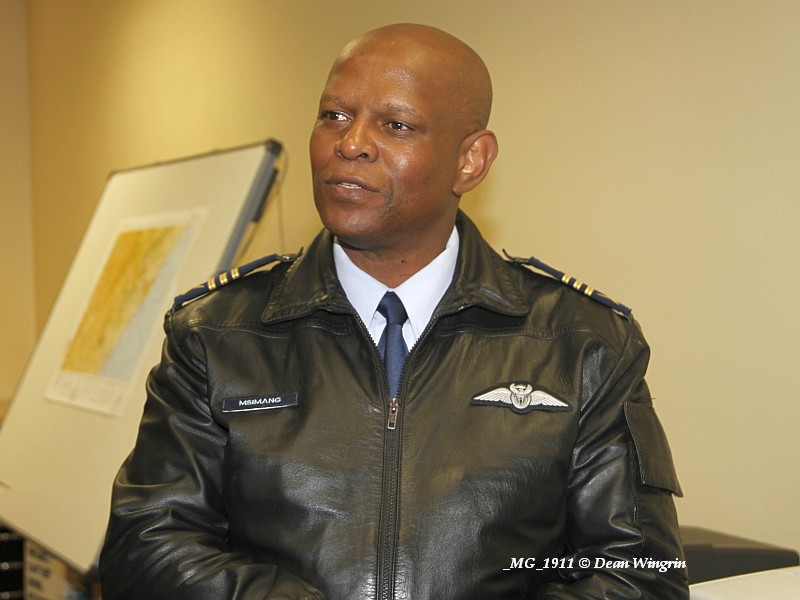
SAAF Chief optimistic on the future
Date: 29 July 2013


By Dean Wingrin
The Chief of the Airforce, Lt Gen Fabian Msimang, is optimistic about the future of the South African Air Force, despite the serious challenges it faces.
Speaking informally to officers and staff of 80 Air Navigation School (80 ANS) at AFB Ysterplaat this past weekend, Msimang told the audience that he was “inundated with challenges” at SAAF Head Quarters and that it was uplifting and gratifying to see “that we do have pockets of excellence within these trying times.”
Msimang was responding to a briefing on the activities 80 ANS and a tour of their modern training facilities, complete with computer-aided training devises and a mock-up aircraft simulator.
The SAAF has been in the news this past week for all the wrong reasons, with allegations of critical budget deficiencies, lack of aircraft serviceability, low flying hours and poor morale amongst the aircrew.
One of the primary reasons for the poor serviceability of the SAAF aircraft fleet was the cancellation of the Denel Aero Manpower Group (AMG) servicing contract with effect from April 1, when the SAAF’s air servicing units lost 389 skilled maintenance technicians. Deployed to various SAAF air servicing units (ASUs) across the country, just 139 specialists were retained in terms of a negotiated skills supply agreement.
An inadequate budget has also resulted in half the Gripen fighter fleet being placed in storage, the Agusta A109 Light Utility Helicopter fleet being grounded, flying hours per pilot being cut by as much as two-thirds and numerous serving and maintenance contracts being placed on hold.
Referring to the activities of 80 ANS, Msimang congratulated Lt Col AJ "Cassie" de Castro, Officer Commanding of the unit, for keeping up the standards of the SAAF.
“This is the little we can do during these trying times for our future,” Msimang noted.
Continuing, Msimang said that the airforce was going through very difficult times.
“I’m speaking to you of the future. Please do not despair, we are doing everything possible within our means to ensure that we secure the future. I’d really like to see many of you remain in the airforce and help build this (organisation) up.”
Whilst steering away from any reference to budgetary issues, Msimang briefed the audience on various projects and tasks he was working on to secure a positive future for the embattled service.
The Defence Force is generally regarded as being too top-heavy, particularly that of the SAAF, with observers stating that the SAAF now has more Generals and far fewer aircraft than during the Border War.
Msimang revealed that he was in the process of restructuring the airforce, “because the way it is configured right now is not working optimally.”
“For us to survive,” Msimang said, “we need to ensure that we are properly configured and also properly equipped. “
Although Msimang did not go into details as to how the new structure would look, the reconfiguration would most likely result in a flatter organisational structure than that presently utilised.
The dreams and aspirations of individual members would also be looked after. The airforce was looking at the way they addressed training and career progession, recognising that they were working in silos.
“We still have staff challenges,” Msimang observed. “One of my challenges is that we have not put a lot of effort into career management.”
Explaining further, Msimang noted that the airforce, as a result of planning in silos, did not maximise the potential of individuals to use them effectively. As a result, the airforce found itself “overstocked with senior personnel.”
“It is my aim,” Msimang continued, “that we must immediately ensure that each and every member has at least a three to six year (career) horizon.”
This would give that member a picture to the future.
“We need to make sure that we manage our soldiers together, also taking into consideration families and aspirations. So it’s going to be a two-way engagement, between us and the member,” Msimang said.
Msimang also referred to the Denel/AMG contract, noting that the cancelation thereof was not an Airforce decision. It was clarified that the contract was AMG was evergreen and had been running for many years.
“The Auditor-General had an opinion that we had to end it because it was not conforming to the Public Finance Management Act, so we had to do something,” explained Msimang.
As a result, the Airforce had to ensure that they did not lose all the AMG personnel at once. A SSA (Skills, Service and Training) contract was entered into with Denel on how to manage the AMG personnel in the future.
Although the future use of external technicians was unknown, Msimang admitted that the SAAF has to move on and find other alternatives.
“But having said that,” Msimang continued, “we must always ensure that we build our own organic capability. It is important.”
This was particularly so when the SAAF is required to deploy and thus had to ensure they had their own support capability.
Msimang stressed the importance for everyone within the organisation to mentor and assist their fellow members. In this way, the Airforce can make sure that standards are maintained and remain relevant.
Looking to the future of 80 ANS, Msimang revealed that various foreign countries had expressed an interest in sending their student navigators to train in the SAAF.
It was thus important for the SAAF to understand the accommodation, logistic and capacity of hosting foreign students at AFB Ysterplaat. Another issue being investigated is to determine if a separate course should be held for the foreign students, or to integrate them with the SAAF students.
It is clear that the Chief of the SAAF is grappling with the many and varied challenges facing his organisation. Drastic action needs to be taken, but without an increased budget, it may be too little. Acceptance of the updated Defence White Paper, strong political support and a more accommodating National Treasury is required to save the SAAF.
