


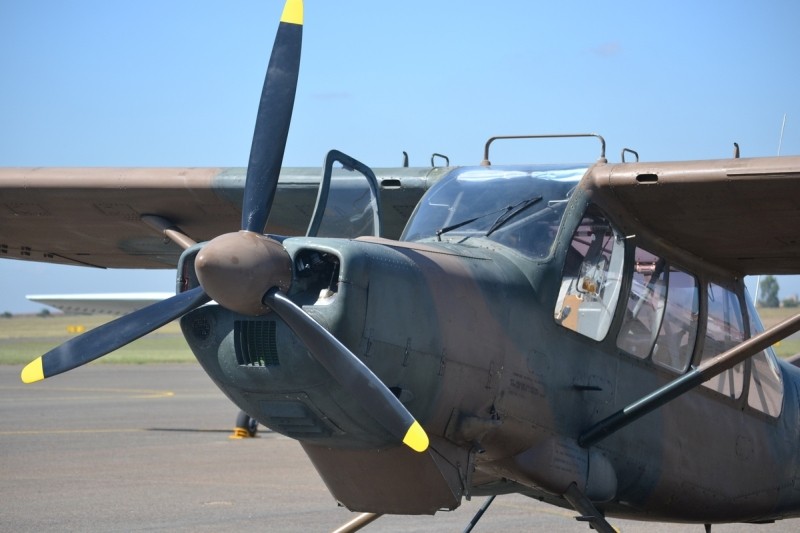
Unique Bosbok flying at SAAF Museum
Date: 7 April 2014


By Janet Szabo
Warbird enthusiasts were treated to the maiden flight of a restored Bosbok battlefield reconnaissance aircraft as well as the return to the skies of old favourites, the Albatross maritime reconnaissance aircraft and the Puma utility helicopter at the South African Air Force Museum's April flying day this weekend.
Speaking about the significance of this particular Bosbok to the museum, Historical Research Officer Colonel Graham du Toit said: "The Aermacchi AM-3CM Bosbok 920 was the first aircraft delivered to the SAAF. This light aircraft was specifically designed for carrying out battlefield reconnaissance and is also equipped with wing hard-points for carrying offensive weaponry. The SAAF Museum is now privileged to have 920, which was the first one delivered and 959, which was the last one delivered. The Rwandan air force operated three of these aircraft for a short while but they were returned to the manufacturer leaving the SAAF as the only operator of this aircraft type in the world.
"What makes this aircraft unique is that it is still in what we call its operational configuration. It hasn't been civilianised. The special heat dispenser pods that break up the heat signature from the engine exhaust are still in place and the flare chutes are still in place and the cockpit still retains the weapon arming panel. The aircraft also still retains its military camouflage pattern".
This aircraft was deployed in operational area of Owamboland and later at Rundu in Namibia during the 1980s. During this period, the pilot, Lieutenant D.J. Laubscher, was awarded the Honoris Crux, the highest award for an act of bravery in a situation of extreme danger while flying this aircraft.* After the aircraft was finally retired in 1992, it was flown to the SAAF museum's satellite branch in Port Elizabeth. It was last flown there in 1999.
In 2013, a decision was taken to move all the historic aircraft in an airworthy condition to Zwartkop. About two months ago, an aircraft company at Wonderboom Airport outside Pretoria undertook to service and repair it. The rudder had suffered some minor damage when it was transported by road to the museum from Port Elizabeth.
The museum's other Bosbok, 959 has been a regular feature at the monthly flying days for several years but this aircraft has been modified for use as a civilian plane, painted grey and has had the military-specific items removed.
Colonel Du Toit said that to completely restore Bosbok 920 to its military configuration, some minor aspects still need to be attended to. "The museum intends to acquire wing pylons in order to mount rocket pods back onto the wings. This will give members of the public an opportunity to see exactly how this particular aircraft looked when it flew in one of its operational configurations during the border war."
An enthusiastic Col Du Toit, who has flown in a Bosbok on a number of occasions, reminisced about some of the particular characteristics of the aircraft: "Members of the Air Force nicknamed the Bosbok the ‘converter' - as it basically converted fuel into noise as its Piaggo-Lycoming 6-cylinder engine is quite loud for an aircraft of its size. Flying in this aircraft at low level at midday in the operational area when the outside air temperature was 35 degrees plus was a very bouncy affair. On occasion, I actually witnessed pilots climbing out of their aircraft looking quite green".
Meanwhile, the Museum's Lieutenant Colonel Clive Shepherd said he was pleased to see the Puma and the Albatross flying again after maintenance work had grounded the aircraft for about 3 months. "Because of the holidays during December and January and other priorities, the Puma needed one or two maintenance issues carried out at Denel. The Albatross we got going ourselves. One of the cylinders needed to be replaced. It was a time-consuming delay."
The next Museum flying training day will be on Saturday 3 May. Then pilots of the historic aircraft are expected to practise their show sequences ahead of the annual SAAF Museum air show on Saturday 10 May.
* This story, as told by the pilot himself, is contained in the book Tumult in the Clouds, available f rom http://www.saairforce.co.za/shop/product_info.php?products_id=1249
