


Hard to ask for more funding when currently limited budget gets poor return – Mbambo
Date: 5 November 2025


It is difficult to ask for additional funding from government when the limited amount the South African Air Force (SAAF) already receives leaves little to show for it, according to SAAF Chief, Lieutenant General Wiseman Mbambo.
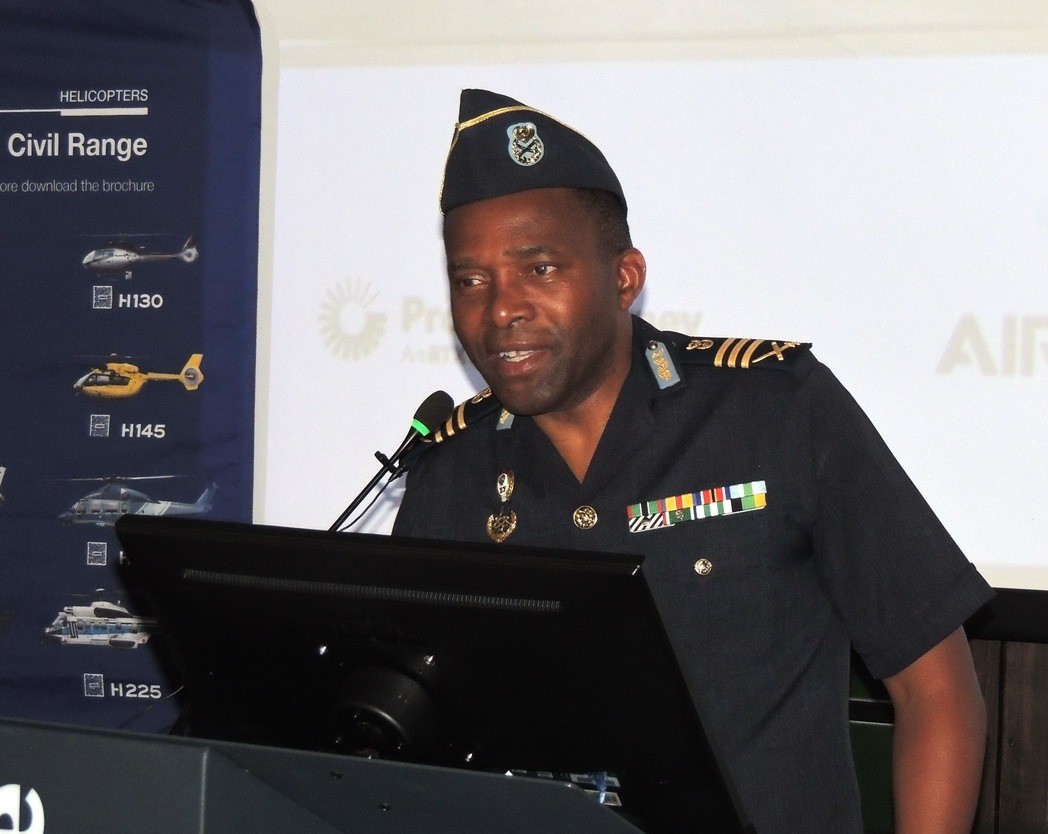
Speaking at the recent Aerospace Indaba organised by Creative Space Media and hosted at the Gordon Institute of Business Science (GIBS) in Johannesburg, Mbambo said receiving a “miniscule” budget means only a certain level of capability can be achieved. This poor showing makes it hard for the holders of the purse strings to provide more funding as they are not seeing good return on investment on the little that is provided.
Mbambo explained that this problem is most evident in the supply of spare parts for aircraft. It might take up to a couple of years to acquire spares due to underfunded maintenance programmes, meaning long periods of time go by before aircraft can be made serviceable. As a result, “it’s extremely difficult for us as end users to go and argue for additional funding whilst the limited funding means you have nothing to show,” Mbambo said. “There’s no way you can convince politicians you need money because there is nothing to show.”
State defence materiel agency Armscor in mid-June this year told the Joint Standing Committee on Defence (JSCD) that the South African Air Force faces a R7.7 billion shortfall to fund aircraft support contracts over the next three years, with Armscor saying the SAAF maintenance budget should be two to three times what it currently stands at. Only the bare minimum maintenance is being done, meaning that a large recovery cost is required to “catch up” on maintenance. Although Armscor is only able to place bare minimum ‘on demand’ maintenance contracts, this does not guarantee aircraft availability.
Armscor warned that years of underfunding have reduced the serviceability of the fleet and impact the DoD’s ability to provide a transport capability e.g. transportation of troops and resources.
Further compounding the serviceability issue is that while underfunding has reduced SAAF capabilities, this does not mean natural disasters and other events requiring SAAF intervention are limited as well – on the contrary, they are escalating, Mbambo said, adding today’s world is often marked by unpredictable crises.
Given a volatile, uncertain, and complex world, innovation and partnerships are needed to tackle issues facing the aerospace industry, Mbambo told the Aerospace Indaba. “Failure to adapt will result in the stagnation and death of public and private aerospace industries.”
“In crises nations can retreat or arise. Our gathering confirms our resolve to national resilience in the form of human resources, intellectual property (IP), and infrastructure development,” Mbambo told the Aerospace Indaba, and called for enhanced innovation, the protection of IP amid rampant theft, and cooperation amongst the industry. “When it comes to IP we must protect it with everything we have. It is a matter of survival for current and future generations.”
He noted South Africa’s reputation for innovation and entrepreneurialism, creating innovators like Elon Musk and Mark Shuttleworth, amongst others, needs to be tapped into.
“The ability to protect the future lies in our ability to create it. We must be proactive in deciding what South Africa’s aerospace future should look like. We have the opportunity to piece together that future and must break down silos and accommodate all relevant stakeholders.”
Mbambo, in his keynote address, added that “we cannot afford to be risk averse as we stand at the crossroads of national and international crises. Adversity is not a roadblock but a stepping stone. Through collaboration we have the chance to rise above challenges and forge a unified response to global aerospace challenges.”
The 2025 Aerospace Indaba saw leaders from across the aviation spectrum — from general aviation and manufacturing to defence, finance, and technology — discussing how collaboration and innovation can drive sustainable growth in South Africa’s aerospace sector.
Programme Director Renè-Peter Masoen described the Indaba as “a platform to turn discussion into direction,” highlighting the need for both government and industry to reimagine South Africa’s role in global aviation.
Kaval Shah from Pratt & Whitney Canada outlined how technology-driven partnerships and predictive maintenance are reshaping aviation operations worldwide. He pointed to the growing importance of collaboration between OEMs and local operators to improve fleet reliability and build South African technical capacity. Pratty & Whitney Canada works closely with the SAAF, and can combine Air Force expertise with OEM efficiency and technology to improve engine serviceability, he said.
Adding a global perspective, Nam-Binh Hoang, Managing Director of Airbus Southern Africa, discussed the company’s expanding footprint in training, maintenance, and uncrewed systems. He noted that South Africa’s mix of industrial expertise and regional demand creates a strong base for growth in general and commercial aviation alike.
Panels throughout the day examined the state of general aviation, next-generation manufacturing, skills development, and financial resilience. Speakers including General Isaac Moreetsi of the SAAF, Bruce Fraser of Starlite Aviation, Thato Matsha of Investec, and Biko Managa of the Council for Scientific and Industrial Research (CSIR) who stressed that building a competitive aerospace sector requires coordinated policy, local innovation, and accessible funding to support new entrants and small operators.
Closing the Indaba, Shai Shalem of Safomar Aviation called for unity across the value chain, noting that “the strength of South African aviation lies in how effectively we connect its parts — from pilots and engineers to financiers and policymakers.”
The 2025 Aerospace Indaba reinforced that South Africa’s future in aviation depends on rebalancing priorities between defence and general aviation — building local capability, nurturing skilled professionals, and creating an environment where innovation and investment can thrive.
Republished with permission of defenceWeb.
