


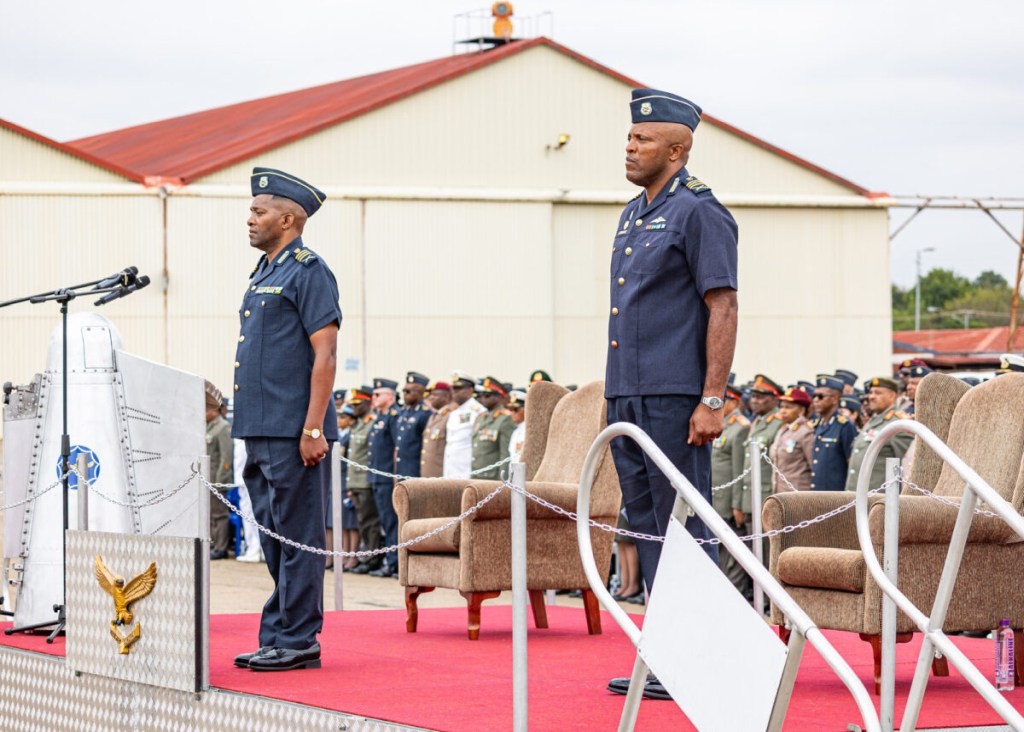
New SAAF Chief to build on foundation for next 100 years
Date: 1 April 2026


In a media briefing shortly after taking command of the South African Air Force (SAAF) at a Change of Command parade in Pretoria on Tuesday, Lieutenant General Carl Moatshe stressed that he would focus on skills development to build the Space Command established by his predecessor, Lieutenant General Wiseman Mbambo.
In a media briefing shortly after taking command of the South African Air Force (SAAF) at a Change of Command parade in Pretoria on Tuesday, Lieutenant General Carl Moatshe stressed that he would focus on skills development to build the Space Command established by his predecessor, Lieutenant General Wiseman Mbambo.
“The Air Force was structured for a purpose and the people we have in the Air Force are there to care for that mandate and structure,” Moatshe stated. “The Space Command handed to me needs air personnel with the proper skills to take the Air Force forward into 2100 and beyond.”
Moatshe was handed the ceremonial dagger of command during an impressive parade at the Air Force Mobile Deployment Wing (formerly AFB Swartkop) on 31 March. Present at the ceremony were Minister of Defence and Military Veterans Angie Motshega, Chief of the SANDF General Rudzani Maphwanya and former Chief of the SAAF Lieutenant General (Ret) Fabian “Zakes” Msimang, among a host of dignitaries and hundreds of spectators.
In his farewell address, outgoing air force chief Mbambo explained the SAAF’s strategic decision to chart a new direction and vision, namely an effective air and space power through innovation in the theatre of operations.
“This came under the difficult moments of limited funding confronting the Department of Defence and by implication the SAAF,” Mbambo said. “Members of the organisation were largely preoccupied with the key question of additional funding to have more platforms in the air.”
He said the vision of air and space power at that time sent shockwaves in various sectors of the SAAF because of its controversial nature, considering the SAAF’s limited resources.
“I am a firm believer in the dictum that says… ‘if your vision is not intimidating you, then it is not worth pursuing’ and it dawned on me that unless the SAAF leadership forges ahead with this vision – there is a danger that the SAAF could focus on the immediate and lose sight of the ultimate.”
He stated that the resolve was clear and unambiguous, namely, to push on with the vision and once the leadership had “determined the flight path of effective air and space power – the rest had no choice but to follow,” he affirmed, saying that was the nature of military culture.
Mbambo further noted that a slogan was developed – ‘Free the Eagle’ – through which SAAF members were encouraged to embrace the new approach.
“The Space Command Integrated Project Team (SCIPT) under the guidance of deputy chief of the air force Major General Mathebula has achieved notable results within a short space of time,” he stated. “We have made strides in the collaboration and partnership with various space entities in the country, including space conferences that have changed the individual approach of the pursuance of a national space programme towards an integrated approach.”
Another initiative he outlined was in-house capability development (DIY) through which air force members were encouraged to innovate without relying on external input. Already “the mindset of SAAF members has been pulled to new levels…like a stretched coil spring that never returns to its original state once released,” Mbambo asserted.
“In Air Force Base Bloemspruit, some amazing achievements at 6 Air Servicing Unit are unfolding and similar innovative actions are mushrooming throughout the SAAF. In the recent SAAF gala evening we awarded 4 members with innovative trophies who have developed amazing solutions for challenges at base and unit level.”
With the SAAF being cash poor and asset rich – the latter with a limited shelf life, which will result in disposal without gain to the defence force – public and private partners have been called upon to help resolve the conundrum.
Turning to current conflicts and global uncertainty, Mbambo believes the SAAF should learn from the chaos.
“The space domain, UAVs, AI, cyber warfare and digital technology are a game changer in military operations,” he stated. “The future airman must be able to utilise these capabilities, but most importantly be able to fight against them when the adversary is using them.”
In this regard he lauded the local defence industry which is prepared to partner with the SAAF and ensure that the air force remains capable.
In closing, the outgoing chief congratulated his newly appointed successor, saying Moatshe was experienced, having started his career at unit level and rising through different settings within the organisation. The Air Force Command Council was also available to guide him in taking the Air Force forward.
Responding to a DefenceWeb question on the Air Force’s participation in the forthcoming Africa Aerospace and Defence show (AAD 2026), the new Air Force chief said it was a somewhat unique event.
Unlike airshows such as Farnborough, which are focused primarily on trade, the local event comprises three days of trade, followed by two days of air displays that are very popular with the public.
He believes that AAD’s public airshow depends heavily on the SAAF and general aviation to bring an exciting angle to the event.
“Therefore, it is key that the Air Force participates to make the airshow a success,” he affirmed. “Even for hosting the trade days, one should note that AAD is based on the Waterkloof Air Force Base, which has always been its home.”
Republished with permission of DefenceWeb.
