


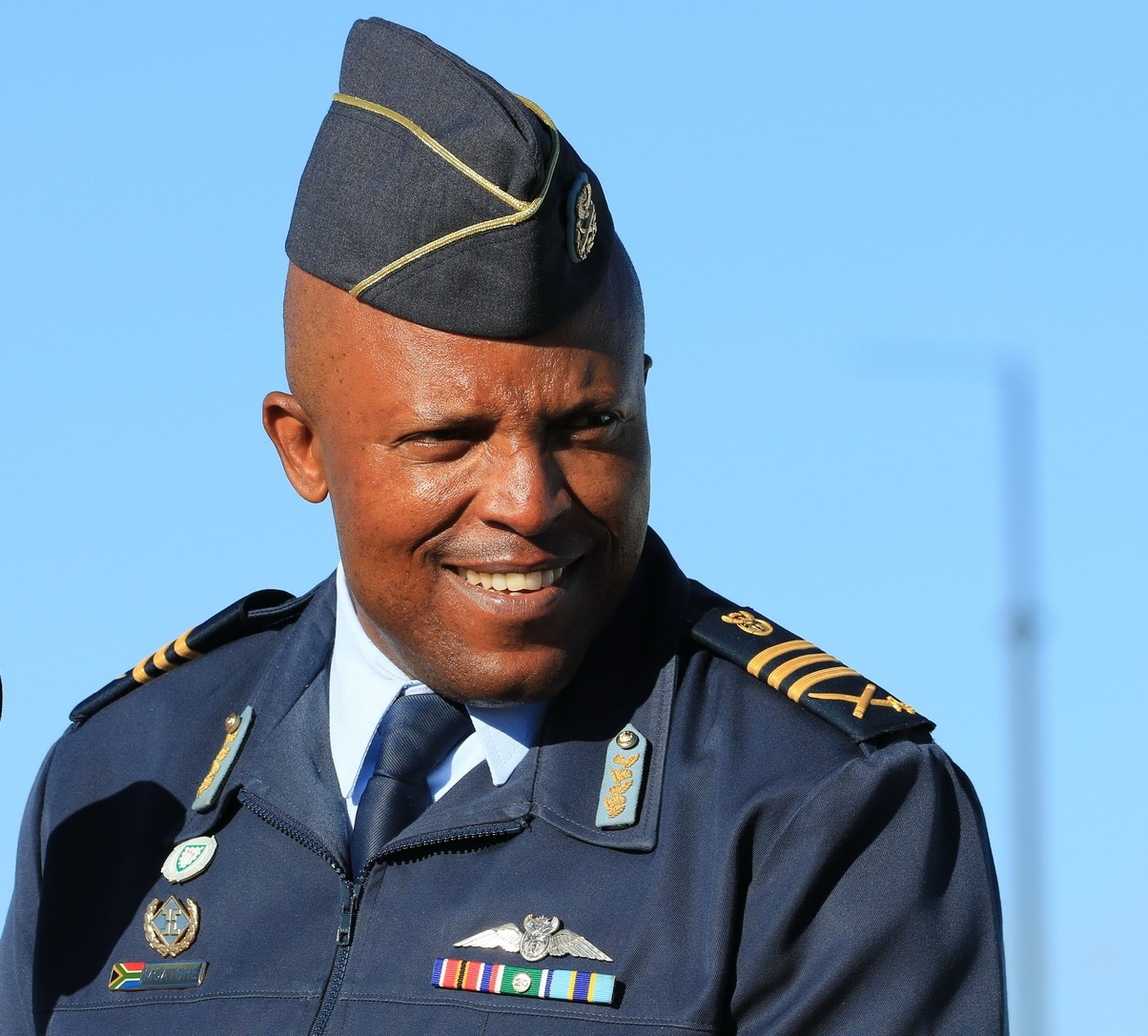
How the SAAF’s new Chief plans to do more with less
Date: 15 May 2026


By Dean Wingrin
Having conquered four Comrades Marathons, Lieutenant General Carl Moatshe is no stranger to discipline and overcoming formidable challenges.
It has been over a month since Moatshe took over command as the new Chief of the South African Air Force (SAAF), with effect from 1 April 2026. DefenceWeb recently sat down with him to discuss his plans and vision for the next five years, where he emphasised people-centred leadership and empowerment under a severely constrained budget. An upcoming workshop will determine how the SAAF can meet these challenges.
Moatshe is modest about his appointment. “It’s something that I don’t take for granted,” he said. “It’s a privilege, it’s an honour. But at the end of the day, it’s not about the Chief. It’s about mobilising close to 9 000 Air Force members to produce the mandate, which is air defence.”
However, Moatshe made it clear that the concept of air defence itself is evolving: “With changes in technology, change in warfare… updating the doctrines… is the structure still fit for that purpose? … I think there’s part of the structure that is outdated.”
Chief among those demands are drone capabilities and space.
“Everybody’s buying drones, but… which ones are actually Air Force drones?” he asked. “Do we elevate the Air Force drones to strategic drones?”
He pointed out that historically the SAAF has operated largely at a tactical level. “Since 1920… the South African Air Force has never been strategic… we’ve always operated at an operational level, tactical level, the Air Force in support of the Army. And we’ve never stretched our missions beyond our region.”
Out of area operations, such as that during the Second World War and Korea, have always had the logistical support of other allied nations. However, he points out, there were some strategic elements, such as the Boeing 707 tanker.
The establishment of a Space Command represents the most dramatic shift in the Air Force’s self-conception since its founding.
“Air power should change to air and space power,” he said. The question of whether Space Command ultimately becomes a national, joint-force capability (rather than purely an Air Force one) is something Moatshe said will need to be resolved collectively.
But, the new Chief said, “behind every capability, there’s a human element. So who’s going to manage this process?”
Underpinning all of this is what Moatshe described as his most pressing priority: human capital. For Moatshe, people remain the decisive factor. “I call them the weapon systems,” he said of SAAF personnel. “You cannot replace that weapon system… you keep on equipping them, you keep on upgrading them.”
He highlighted the need to rethink training and professional development. The military and its culture struggles to accommodate the younger digital generation entering the Defence Force. “The youth today want independence of thinking. It’s not a bad thing, but you struggle to match them traditionally.”
Rather than suppress that impulse, Moatshe said he intends to harness it. He recounts how, as Chief Director Force Preparation, he challenged a group of young airmen to reimagine the business card. Within a week they had produced a digital card embedded in a blank that activates on contact with a smartphone.
“You need to give them that opportunity… there’s things that they do with the system that is actually unheard of,” he said. “If I limit them to what I know, then I’m denying the Air Force the opportunity to grow,” he said.
Moatshe is largely reassured on recruitment quality. The SAAF’s entry requirements, particularly for engineers, pilots and navigators, remain high. The challenge lies not in attracting talent but in cultivating it once it arrives.
“What type of courses are you going to put in place to re-capacitate this human capital?” he asked. “What courses are going to happen at the Air Force College?”
He pointed to the model used by countries like India, where staff college graduates are retained as assistant directing staff and then dispatched to foreign staff courses, returning with a layered, multicultural grounding that feeds back into local staff courses.
“The product that comes out of that is an experience of multiple cultures and methods of training in different countries, integrated with the foundation of the local staff course,” he said. “Their level of finishing is completely different.”
So, given that Treasury is unlikely to dramatically increase defence funding in the foreseeable future, where does the SAAF direct its limited resources to remain a credible force into the next century?
Moatshe is under no illusions about the fiscal reality. “One should not ignore the fact that we are an unfunded Defence Force. We need to do more, cover more ground with the little that is allocated.”
In that context, he sees the integration of existing systems, Council for Scientific and Industrial Research (CSIR) research, space sensing, and maritime domain awareness, as more achievable than wholesale procurement. “The integrations of those systems are what we need to focus on,” he said, citing the dramatic miniaturisation of computing power as proof that cost need not be a barrier to capability.
He pointed to emerging threats such as drones and autonomous systems with AI. “That precision drone… it’s actually a very advanced guerrilla,” he said. “How do you deal with it?”
Looking to the future, Moatshe warned that technological change is reshaping warfare. “You can have all these gadgets… and then you go into war, you lose against somebody that’s got a system… one-eighth of your cost with greater capability than you have,” he said.
Operational demands also remain pressing: maritime patrol, search and rescue across South Africa’s vast continental shelf, air mobility for the Army, border surveillance.
“How do I support the Navy at sea? How do I support the Army… with air mobility…?” he asked. “There’s still the tactical and operational part that we still have to play.”
“The (maritime) borders are there… but because they are imaginary elements at sea, you actually need to police them,” he said. “If you are not there, that border in principle does not exist. The vulnerability of our blue economy carries a huge burden.”
The upcoming work session in June, bringing together Air Force leadership, academics and industry, will be critical to translating this philosophy into doctrine. This, he hopes, will challenge the minds present.
“If we go there and we don’t come up with the answer,” Moatshe quipped, “it’s going to be like the Conclave: We’ll blow the black smoke until the white smoke comes out.”
Noting the recent increase in aircraft availability as a result of measures implemented over the past few years, Moatshe suggested that the Air Force’s motto of “Free the Eagle” has done its work.
“The eagle is freed. Now I need to fly this freed eagle,” he remarked.
For Moatshe, flying it means regenerating the mindset of his force, positioning it for a century of challenges that are only beginning to take shape, and trusting the people and senior leadership around him.
Ultimately, Moatshe returns to the central role of people. “The appointment is about the Air Force… about serving the nation… about bringing the people together,” he said.
Republished with permission of DefenceWeb
