


A new flight plan
Date: 14 October 2005


By Peter Honey
State and industry rally to the challenge of SA's manufacturing partnership with Airbus.
South Africa's aerospace industry is heading for a renaissance, after gradually declining since it was orphaned by the death of apartheid-era militarism in the early 1990s.
The dramatic revival will bring a shift of focus from low-volume military production to international manufacturing partnerships in high-volume commercial aircraft production. Already, significant SA aerospace companies are negotiating with Airbus for partnerships in the design and manufacture of important subsystems in the future A350 airliner. They are also vying for work in the recently launched A380, and expect future contracts in programmes of both Airbus and Boeing.
The change looks certain to hasten the unbundling of government's troubled Denel aerospace and land-systems conglomerate, forcing the divisions to forge new alliances with other SA high-technology companies that have until now remained competitively aloof.
The catalyst for this incipient manufacturing revolution is government's bold, multibillion-rand buy-in to a club of seven European countries to develop and manufacture the new-generation air transporter, the Airbus A400M.
SA is buying eight of the planes for a reported R6,4bn (some sources say R8bn), with first delivery in 2010. In return, two important SA contractors have received guaranteed design-and-build contracts worth about R3,2bn, and expect further orders worth another R3bn in the first 15 years of production.
The European construction partners - Germany, France, Spain, UK, Turkey, Belgium and Luxembourg - have already ordered 180 of the aircraft (in addition to SA's eight). As new customers place orders, though, and the customer base expands, the SA contractors and subcontractors will be assured a stream of work from this one programme, which is expected to remain operational for 50 years.
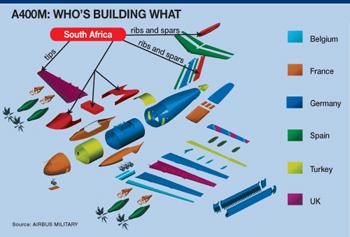
State-owned Denel Aviation and privately owned Aerosud are the prime SA suppliers to the A400M of such components as wing tips, wing-to-fuselage fairings and thermoplastic linings for the nose fuselage and cargo hold - products in which SA aerospace companies excel. But, as outlined below, industry players and government will have to scramble to promote more niche technologies and ensure SA remains a global player in the lucrative market for aircraft subsystems and lightweight composite materials.
Government's abrupt announcement of the A400M deal in April this year brought sharp rebuke from analysts, who questioned why government had not opened the contract to tender, or pursued cheaper options. Also, the unexpected first payment of R763m that government has had to make this year towards the A400M purchase - most of it from annual defence spending - has severely depleted the defence force's already strained operational capacity.
Though there has been no evidence of corruption in the deal, rumblings of "another arms deal scam" can be heard from the antimilitary lobby.
Though the purchase itself may be open to question, the scope of the commitment goes far beyond "another weapons purchase", and industry chiefs are understandably ecstatic.
"Government's decision to buy in at ground level with just seven other countries is hugely important. It's massive," says Aerosud group GM Paul Potgieter. "It's not so much the packages in the A400M that matter as the risk-sharing partnership. It is going to make a huge difference to our industry."
Government has largely itself to blame in underselling the A400M deal. A senior official involved with the programme tells the FM that a decision was taken at cabinet level late last year to say little about the deal in public because of fears it would raise the political heat around Jacob Zuma's alleged corruption and the trial of his financial adviser Schabir Shaik for corruption linked to an arms deal contract.
But there is much to appreciate in the A400M partnership arrangement. For a start, it precludes SA offset liabilities in the purchases, which it would have had to endure if it had been an ordinary customer.
Also, in the financing of SA's sub-contracts, the agreement bridges the problem of SA's high cost of capital - about 13% compared with Europe's average of around 5% - by requiring Airbus Military to pay SA contractors immediately upon receipt of payments from the SA government. This obviates the need for the companies to make costly borrowings. Normally, subcontractors have to wait for the final sale of an aircraft before receiving payment.
The A400M deal dovetails neatly with the department of trade & industry's (DTI) efforts to promote aerospace, along with other high-value, advanced manufacturing sectors such as vehicles, diamond cutting, information & communication technology, pharmaceuticals and biotechnology, to make SA more globally competitive and able to retain valuable skills.
The global aerospace market is expected to grow by 25% in real terms over the next 20 years to US$250bn/year, and the number of airliners in service will double to about 20 000 by 2020, says Francois Denner, chief director of strategic competitiveness in the DTI's enterprise & industry development division. SA must move swiftly if it is to retain and grow market share against fast-rising China, India and Brazil in the hi-tech stakes.
Manufacturing is a valuable contributor to GDP growth, says Denner. Exports of hi-tech manufactured goods are growing faster internationally than lower-technology goods or resources. Aerospace is expected to feature strongly in the industrial policy framework that the DTI plans to submit to cabinet in 2006. The emphasis will be on expansion.
Though just two SA companies are directly contracted to the A400M project, neither will be able to do the work alone. They will have to outsource to smaller, specialist companies and black economic empowerment partners. There will thus be a cascade effect in terms of technology.
"We will need a supplier base, with sheet-metal works, machining plants, composite manufacturers, assemblies and so on. It will make sense for there to be a geographical clustering," says Denel Aviation's executive manager for business development, Theo Kleynhans.
Government and industry are co-operating to establish aerospace "technology villages"; one on the vacant land around the Aerosud plant in Centurion and the other in the vast Denel Aviation facility near Kempton Park. The DTI, the department of science & technology (DST) and the Gauteng provincial government are working together to encourage complementary industries to set up shop in the villages, which will provide favourable lease arrangements.
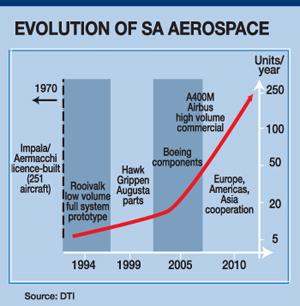
Perhaps the greatest challenge for the primary contractors will be to adapt manufacturing processes to high-volume production. SA's aero industry grew out of a need to supply a sanctions-era SA military. That meant relatively small-volume, low-industrialisation production (see evolution graph).
In the early 1990s SA produced its only hi-tech, domestically designed and built attack helicopter, the Rooivalk - an extraordinary feat, but hugely expensive and in low volume - just 12 were built.
The industrial participation contracts flowing from the arms deal - specifically the construction of components for the Gripen and Hawk jets purchased by the SA Air Force - provide little scope for domestic design or industrialisation, as the parts are built mainly to specifications and designs drawn up in Europe and Scandinavia.
What is required is first- or second-tier manufacture - if not the entire aircraft system, then major subsystems such as those related to wings, fuselage design and construction, and unique materials, such as graphite composites and innovative manufacturing processes - technologies that are rare and difficult to replicate.
"The big challenge is relevance," says Aerosud's Potgieter. "If we can only compete on the basis of brute-force manpower rates then we shall come second." As Denel Aviation's Kleynhans puts it: "If you reach the point where your technology doesn't give you an advantage over the guy in China, you're stuffed."
The A400M contract is the first to require specialist SA design and production, not just for a small number of units, but for hundreds of commercial planes over a protracted period. The true value lies in the relationship and follow-up contracts with the commercial Airbus division. But these will throw up daunting challenges as well.
"Our mass production skills are still low. We lack the processes and trained personnel to cope with high volumes," admits Kleynhans. "We still have problems with industrial engineering efficiencies and bottlenecks. But we are working hard to overcome these."
Denel has more than 20 engineers in service at the Airbus facilities in Toulouse and Hamburg, working on commercial airliner programmes, learning mass production processes and skills.
The company is aiming to become the world leader in designing and constructing wing-to-fuselage connections and fairings. Kleynhans says it has set a production target of 250 units a year. "At least our primary inputs (salaries, rentals and energy costs) are low, so we are not at a disadvantage there," he says.
For all its controversy, the arms deal offset work with Saab on the Gripen contract has brought concrete benefits. Saab's manufacturing systems are similar to those of Airbus, and the Swedish company has trained 40 Denel engineers in its processes.
"So, when Airbus came to audit our systems they took only two days because our design and development facilities were much the same as theirs," Kleynhans says.
Financial Mail
