


Hawk software release will open flight path for South African Air Force's Gripen training
Date: 1 September 2006


Release of the Operational Clearance Software Standard 2 (OC2) version of the avionics software, by Advanced Technologies and Engineering (ATE), for the South African Air Force (SAAF) BAE Systems Hawk Mk 120 is planned for this month (September 2006). This will render the Hawk fully operational for fighter-pilot training, with final operational clearance planned for mid-2007.
The delivery of the OC1 version in June 2006 coincided with the commencement of Hawk flight operations at Makhado Air Force Base (AFB) on 5 June. The first two Hawks were handed over to the SAAF on 24 May, and deliveries were scheduled to run in parallel operational clearances. The first 10 aircraft arrived in country during July, with a further seven due this month, and the final aircraft due by the middle of 2007.
The SAAF ordered 24 Hawk lead-in fighter trainers (LIFT) in December 1999 under a USD620 million contract that formed part of South Africa's 'strategic arms packages'. They will replace the MB-326 Impala as jet trainer and LIFT, preparing pilots for the JAS 39C/D Gripens, which will enter service between 2008 and 2011.
The Hawk project suffered some delays as a result of software adaptation problems and the Adour engine failing its initial bird-strike tests. The full software implementation has now been addressed, and the aircraft are now all receiving the production standard Rolls-Royce Turbomeca Adour Mk 951 engine.
ATE developed the navigation and weapons system (NWS) for the Hawk Mk 120 under a ZAR500 million (USD73 million) prime avionics subcontract from BAE Systems, the first time that the latter has placed such a contract with a foreign company.
ATE had previously developed the avionics for the Rooivalk attack helicopter and Pilatus PC-7 Mk 2 Astra primary trainer, as well as the NWS and mission computer for the Spanish Air Force's Mirage
F-1 upgrade. The company also developed a comprehensive modernisation package for the Algerian Air Force's Mi-24 attack helicopters.
ATE is responsible for the installed performance of the system in the SAAF Hawk Mk 120, and has been intimately involved in the aircraft's flight-test programme, conducted at the SAAF's Test Flight and Development Centre (TFDC) at Air Force Base Overberg in the Western Cape.
Using the first aircraft (ZJ970/SA250) built by BAE Systems in the UK, these tests have taken three years. The other aircraft are being assembled by Denel in South Africa. The flight-test programme included the full validation of the system against the contracted specification requirements.
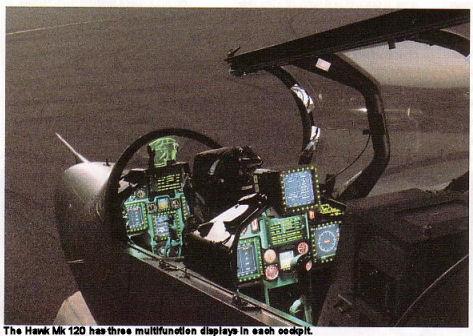
The Hawk Mk 120 NWS has been developed to include South African avionics and weapons systems, integrated with the basic Hawk Mk 120 developed from the earlier Mk 100 series. It provides a fully configurable `glass cockpit' integrated with an advanced navigation and mission computer system and an `intelligent' stores management and weapons-delivery system.
The cockpit and the avionics software have been optimised to familiarise the pilots with the cockpit and systems of the Gripen. Each cockpit has a Thales Smart Head-Up Display (SHUD) that presents full navigation, air-to-air and air-to-ground weapon aiming formats for combat training; three interchangeable colour multifunction displays (MFDs) from Thales, an Up-Front Control Panel and full HOTAS (Hands-On-Throttle-And-Stick) controls, and is fully compatible with night-vision goggles (NVGs).
The entire software package has been developed by ATE, and is being certified to RTCA 178B Level A for the Stores Management Unit, and to Level B for the overall operational flight programme and the individual hardware items, such as the mission computers, displays and audio-management unit.
A particular feature of the Hawk Mk 120 NWS is its radar-simulation function. This approach was selected as the most cost-effective way to provide in-flight radar training, which is vastly cheaper than installing and maintaining a suitable radar in the LIFT or conducting that training on the Gripen itself.
The radar simulation will be used to give future Gripen pilots their initial training in the use of radar in air-to-air combat, and has been designed to give the trainees a close approximation of the capabilities and data that will be provided in that role by the Gripen's actual Ericsson PS-05/A radar.
The radar-simulation system uses a radio-frequency network established among as many as eight Hawks engaged in an exercise. Each aircraft constantly transmits its position via a Link ZA datalink, and each aircraft's mission computer calculates the positions of the other aircraft relative to itself. That picture is displayed as a real-time 'radar page' on the selected MFD.
The radar page has a Range-While-Scan mode as its main mode with the Single Target Track of the highest priority target as a submode. The pilot can also select up to five priority targets. The display will provide action volumes for both an intercept missile and a self-defence missile. Radar targets may also be acquired by searching the H U D field of view, with four radar combat modes available: HUD Search, HUD Slewable Box, HUD Boresight and HUD Vertical Scan.
The Link ZA digital-network protocol was developed by Armscor for South African Defence Force (SANDF)-wide use, and the software layers to integrate it with the LIFT avionics were developed by Thales Advanced Engineering. The data transmission is handled by one of three RDI V/UHF ACR 500 electronic counter-countermeasure (ECCM) radios installed in each aircraft, and is managed by an ATE-developed audio-management system.
The navigation element of the NWS combines a laser-gyro inertial navigation system with a GPS unit to achieve an optimal mix of accuracy (GPS) and continuity (INS). It provides the pilot with steering, time and fuel guidance. That can be in relation to a pre-planned mission downloaded by means of a portable data store, in relation to routes planned in flight or in relation to points selected by the pilot. The portable data store can also be used for post-mission avionic data downloading for debriefing and analysis purposes.
The stores-management system developed by ATE has been fully certified as a 'safety-critical' system to international standards. It provides armament management and control for both air-to-air and air-to-ground operations. It has been developed to the RTCA Level A standard and is being certified to that standard. The Hawk's avionics system has also been developed from the outset with a photo-reconnaissance function integrated into the navigation and weapons system and the man-machine interface.
The electronic-warfare system has been developed by Saab Avitronics for the Hawk, and comprises a radar-warning receiver (RWR) and a countermeasures dispenser subsystem. It has been developed on the basis of the multisensor system developed for the SAAF's fighters, and can later be expanded or upgraded if that is required.
The communications system is fully redundant with three ACR 500 radios, and can be used for voice and data communications, for telebriefing, and for communications relay.
The audio-management system also provides an intercom function, the ground-crew interface and various caution and warning functions, and manages aspects of the radio navigation function (TACAN, VOR, ILS).
Other system elements include:
- the Selex Sensor and Airborne Systems forward-looking infrared (FLIR) system, incorporating a camera developed jointly with Denel;|
- a laser rangefinder;
- Tellumat PT-2000 IFF/Mode S transponder and crypto unit;
- crew actions, flight parameters, events and configuration logging;
- time-stamped HUD video and cockpit audio and voice recording;
- system status monitoring providing realtime recording of system failures and of avionics and aircraft system events, which can be displayed on an MFD and recorded for later retrieval. The aircraft health and usage monitoring system (HUMS) has been developed by the specialist South African company AMS; and
- operational flight trainer programme software for the Operational Flight Trainer developed by BAE Systems Australia and built by Thoroughtec in South Africa for the SAAF.
The integrated avionics are managed by dual-redundant mission computers developed by ATE, and the system runs on a dual-redundant MIL-STD-1553 databus.
Jane's International Defence Review
