


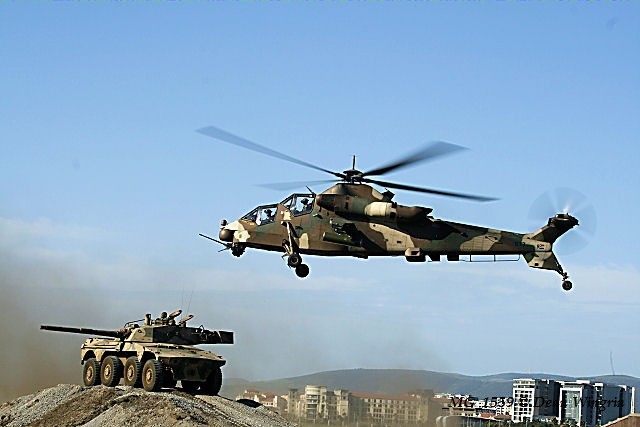
139 changes maketh a Rooivalk Block 1F
Date: 1 October 2010


It takes 130 modifications on the Denel AH2A Rooivalk to turn the current fleet of 11 rotorcraft into a "Block 1F" standard aircraft and a further nine modifications to the aircraft's ground support equipment. Original equipment manufacturer (OEM) Denel Aviation says a major feature of the work is upgrading the sighting system on the Rooivalk for improved reliability.
Other modifications include a new communications management system, the addition of radio navigation equipment, cannon and rocket system accuracy improvements, as well as upgrades to other mission systems, Rooivalk Chief Design Engineer Renier van Rooyen says.
He adds that the more-than-2900 flight hours that have been accumulated on three prototype Rooivalk aircraft and two Rooivalk production-standard aircraft have contributed to the formal qualification of the type. "The mission and weapon systems were evaluated successfully over a range of environmental conditions" says Van Rooyen.
He notes the qualification process is an important development in a long-line of achievements over more than 25 years. Denel in a media release notes Van Rooyen was part of the original team that started with the design of the helicopter in 1984. The company also adds the helicopter now complies with United Kingdom Ministry of Defence DEF STAN 00-970, a "stringent and globally recognised qualification for military helicopters." South Africa reportedly does not have such a standard and is using the UK standard to enable the SAAF Military Airworthiness Board to issue the final type certificate for the helicopter system.
Denel Aviation CE Mike Kgobe has said this "is the first time that qualification of a major helicopter type has been accomplished in South Africa in accordance with international design standards." The Rooivalk is the first and to date only helicopter mostly designed and built in South Africa, albeit with covert assistance from Aerospatiale, the fore-runner of Eurocopter, and Turbomeca, the helicopter turbine engine manufacturer. By about 2006 some R8.1 billion had been spent on the programme, Project Impose. (Kgobe's statement raises a question about the Oryx, for which Denel is also listed as OEM. The Oryx is a fusion of the Puma and Cougar medium utility helicopters with parts for the latter obtained from Romania via Portugal in contravention of a then-United Nations arms embargo against Apartheid South Africa.)
Denel's Group Executive Technical, Major General Otto Schür (Retd), last month (September) said the helicopter would be released to operational service "within the next eight months" when the first five fully-certified locally-designed and manufactured combat support helicopters would be handed over to the SAAF. He said the Block 1F Rooivalk will be handed over for operational duties to the SAAF's 16 Squadron in Bloemfontein by no later than the end of March next year. "The remaining six aircraft will be completed and ready for deployment soon after," said Schür.
The announcement follows similar news from Brigadier General Norman Minne, the Director Air Force Acquisition in the Defence Materiel Division of the Defence Secretariat in July. The air force acquisitions director said the Rooivalk fleet was grounded in November last year "due to some specific issues regarding the engineering support of the aircraft". The aircraft was notably absent from the massive air defence effort to safeguard the June-July soccer World Cup and did not feature in this February's SA Army airborne capability Exercise Young Eagle, as is usually the case. It did return to the public skies at last week's Africa Aerospace and Defence show.
The original Rooivalk was designed as "an attack helicopter and tank killer" to meet the needs of SA Defence Force as it existed in the 1980s, explains Schür. The changing role of the SANDF, which is now primarily engaged in mandated peacekeeping missions meant that aircraft systems had to be adapted to meet the new requirements effectively. "Rooivalk is now a modern, sophisticated, combat support helicopter, ready to be used by the SANDF in any of its potential deployed operations," he says.
The Block 1F platform will from mid-month be subjected to an accelerated flying programme of some 200 hours at the SAAF Test Flight & Development Centre at AFB Overberg in the southern Cape. In preparation for this phase and planned release of aircraft to 16 Squadron Denel Aviation will also be supporting the SAAF with the training of flight and ground crews to regain the required competencies to operate and maintain Rooivalk.
Schür says an important part of the last phase of Project Impose is that Denel Aviation will be fully responsible for the establishment of the deeper-level support capabilities that would be required to sustain flying operations for at least five years. It must also secure an adequate pool of spares on instruction of the DoD/Armscor and take responsibility for all maintenance, repair and overhaul (MRO) work done on the Rooivalk fleet through a formal support contract that must be secured before end-March 2011. "As design authority and original equipment manufacturer we will ensure that the Rooivalk remains fully operational throughout its assigned life," says Schür.
Source: DefenceWeb
